


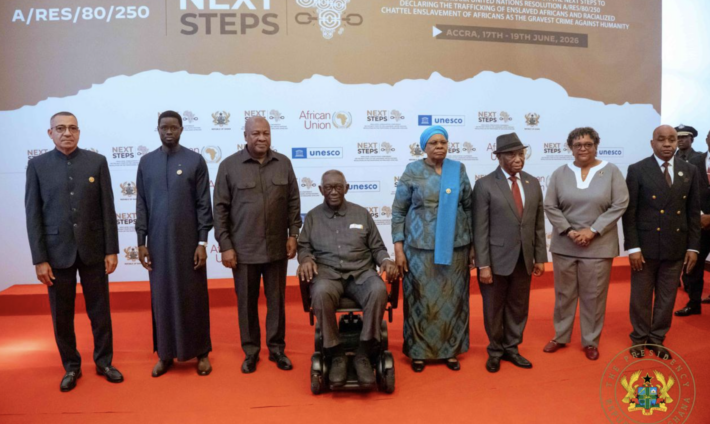
President John Dramani Mahama has announced the establishment of three international panels to drive the next phase of efforts following the adoption of the landmark United Nations Resolution A/RES/80/250, which recognises the trafficking of enslaved Africans and the racialised chattel enslavement of Africans as the gravest crime against humanity.

The President made the announcement during the opening of the High-Level Consultative Conference on the Next Steps to the landmark UN resolution, held in Accra.
The three bodies are the Global Advisory Panel on Reparatory Justice, the Expert Panel on the Restitution of Cultural Artefacts, and the Global Legal Panel on Reparatory Justice.
According to President Mahama, the panels will provide strategic leadership, legal guidance and practical frameworks to advance the global reparations agenda.
The Global Advisory Panel on Reparatory Justice will comprise Heads of State, government leaders and eminent public figures tasked with offering strategic direction. Members include Netumbo Nandi-Ndaitwah, Joseph Nyuma Boakai Sr., Bassirou Diomaye Faye and Mia Amor Mottley.
The Expert Panel on the Restitution of Cultural Artefacts will focus on facilitating the return of cultural properties, archives, sacred objects and historical treasures to their rightful communities.
Meanwhile, the Global Legal Panel on Reparatory Justice will bring together distinguished jurists and legal scholars to examine legal pathways for reparations consistent with international law, human dignity and justice.
The two-day summit in Accra has drawn several world leaders, including President Netumbo Nandi-Ndaitwah of Namibia, President Joseph Boakai of Liberia, President Bassirou Diomaye Faye of Senegal, Prime Minister Mia Mottley of Barbados, Prime Minister Manuel Osa Nsue Nsua, President Carlos Vila Nova and Azouz Nasri.
The conference aims to build on the historic recognition by the international community of the enduring consequences of the enslavement of Africans and the global impact of racialised chattel slavery.
President Mahama said the widely recognised CARICOM Ten-Point Plan would serve as a key foundation for the work of the newly established panels.
He emphasised that the adoption of the UN resolution was not intended to mark the conclusion of the reparations movement but rather the beginning of a broader process of engagement, reflection and action.
Recalling Ghana’s leadership role in the initiative, President Mahama noted that on September 25, 2025, he announced before the United Nations General Assembly Ghana’s intention to sponsor a resolution declaring the trafficking of enslaved Africans as the gravest crime against humanity.
Six months later, on March 25, 2026, the General Assembly adopted Resolution A/RES/80/250 with the support of 123 member states.
“I express profound appreciation to all 123 member states and the many institutions, scholars, civil society organisations, faith leaders, activists and advocates who made this adoption possible,” he said.
The President stressed that Ghana’s commitment to reparatory justice is rooted in its history and moral responsibility.
“For Ghana, this effort is not just an exercise in diplomacy. It is a moral obligation rooted in our history, identity and responsibility,” he stated.
“We do not seek to reopen old wounds. We seek to heal those wounds. We do not seek division. We seek justice, understanding and reconciliation grounded in truth.”
President Mahama observed that Ghana remains one of the most significant physical reminders of the transatlantic slave trade, citing locations such as Elmina Castle, Cape Coast Castle, Assin Manso Slave River Site and Osu Castle as enduring symbols of the era.
“Today, the descendants of those journeys have returned, not in chains, but as presidents, prime ministers, scholars, jurists, activists, historians and citizens of the world,” he said.
President Netumbo Nandi-Ndaitwah of Namibia used the occasion to honour the millions who suffered under slavery and colonial oppression, while reaffirming Namibia’s commitment to restorative justice.
She noted that Namibia’s ongoing efforts to address the genocide committed against the Ovaherero and Nama peoples between 1904 and 1908 form part of Africa’s broader quest for recognition, accountability and redress.
In a televised address, Emmanuel Macron cautioned against viewing reparations solely through the lens of financial compensation.
He argued that genuine justice must also include truth-telling, education, memorialisation and the restitution of stolen cultural heritage.
The conference marks a significant step in translating the historic UN resolution into concrete actions aimed at advancing historical justice, accountability and reconciliation for people of African descent worldwide.


