


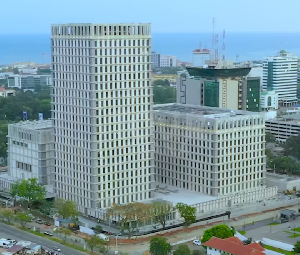
The Majority caucus in Parliament has rejected assertions by the Minority regarding the 2025 audited financial statements of the Bank of Ghana (BoG), describing the claims as a misreading of a technical document that has unnecessarily alarmed the public.

In a statement issued on Sunday, May 3, the Majority said its intervention aimed “to restore clarity, credibility, and truth to the public discourse” surrounding the central bank’s financial position.
The Minority had argued that the Bank’s reported GH¢5.5 billion surplus was misleading, contending that it was derived from total income of GH¢22.2 billion against open market operation costs of GH¢16.7 billion. Central to its critique was a GH¢9.6 billion gain from gold sales, which it characterized as a “one-off” item.
According to the Minority, excluding this gain would reduce income to GH¢12.7 billion, resulting in a GH¢4 billion deficit and placing the Bank in what it termed “policy insolvency.” It further alleged that the Bank sold 50% of its gold reserves to artificially offset this deficit.
The Majority firmly dismissed these claims, stating that they reflect “a fundamental misunderstanding of how the Bank of Ghana operates,” as well as a selective and flawed interpretation of central bank financial statements.
It emphasized that the Bank’s management of reserve assets, including gold, forms part of its core mandate. Gains arising from such activities, it argued, are legitimate components of income, regardless of their non-recurring nature.
“Non-recurring does not mean illegitimate,” the statement noted, adding that central banks routinely rebalance their portfolios, particularly when asset prices—such as gold—rise significantly.
The Majority also rejected the assertion that the Bank is not engaged in gold-related transactions, describing this view as an oversimplification. It clarified that while the Bank does not engage in speculative trading, it actively manages reserves to maintain liquidity and support macroeconomic stability.
In response to the Minority’s recalculated deficit, the Majority argued that excluding the GH¢9.6 billion gain produces an artificial outcome that does not align with how central bank solvency is assessed. It stressed that such evaluations consider the entire balance sheet, including reserves, revaluation buffers, and sovereign backing.
Addressing claims of a distress sale, the Majority stated that the audited accounts show no evidence of forced liquidation, but rather indicate “measured portfolio adjustment.” It further pointed to ongoing policies aimed at increasing gold reserves through domestic purchase programmes, contradicting suggestions of depletion.
The Majority concluded by situating the Bank’s actions within the broader macroeconomic context, noting that Ghana continues to navigate debt restructuring, exchange rate pressures, and global financial tightening.
“In such conditions, active balance sheet management, including asset reallocation, is not a sign of weakness,” the statement said. “It is a necessary tool of stabilisation—evidence not of collapse, but of management under pressure.”


