


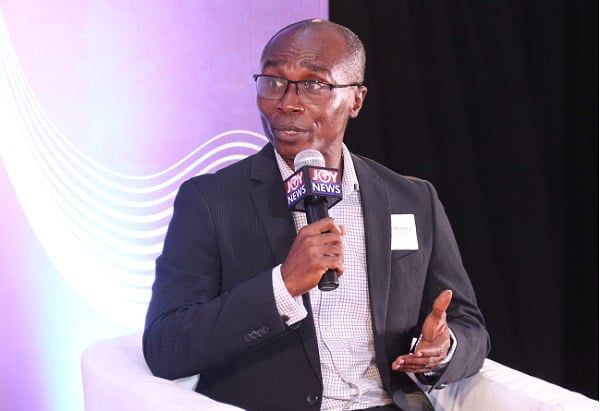
Economist and University of Ghana lecturer, Patrick Asuming, has cautioned that Ghana cannot depend on short-term improvements in the value of the cedi without implementing deeper structural reforms aimed at diversifying the economy.

Speaking on Joy FM’s Super Morning Show while discussing recent movements in the local currency, Prof Asuming said Ghana had managed to stabilise some financial pressures in the short term but remained vulnerable because of its heavy reliance on gold exports.
According to him, concerns should arise when the cedi experiences sharp and sustained depreciation within a short period.
“If we begin to see so much pressure on the currency that, within a short period, we experience massive losses, then you begin to worry because that is when things get out of control,” he stated.
Prof Asuming explained that the recent stability of the cedi had largely been driven by fiscal and monetary interventions implemented by authorities.
“We’ve done part of what we could do to make the currency stable. We’ve implemented the short-term measures,” he said.
He noted that short-term currency movements are often influenced by financial flows, speculation, monetary policy decisions, and fiscal measures.
“Those have been somewhat stabilised,” he added.
However, he stressed that the long-term strength of the cedi would depend largely on Ghana’s balance of payments position, export performance, and the level of economic diversification.
“But over the long term, movements in the currency are determined by what happens on our balance of payments account,” he explained.
“That is how much we are exporting, how much we are importing, and how diversified our export base and economy are.”
Prof Asuming argued that Ghana has not made sufficient progress in building a resilient economy capable of withstanding external shocks.
“In terms of making the economy more resilient, sustainable and diversified so that our exports become less susceptible to global shocks, I think we have not done much yet,” he stated.
During the discussion, he acknowledged that rising global gold prices and increased gold exports had significantly contributed to the recent appreciation of the cedi. However, he warned against overreliance on a commodity whose prices are highly volatile and beyond Ghana’s control.
“Our exports have risen sharply — the highest we’ve seen in a long time,” he noted.
“But what you have to understand is that it is still heavily reliant on the price of gold, which we do not control and which is extremely volatile.”
He warned that while Ghana is currently benefiting from favourable gold prices, the country remains exposed to major risks if global prices decline.
“We are enjoying the upside of that volatility. But if conditions we do not control change and gold prices begin to fall, then the vulnerabilities will return,” he cautioned.
Prof Asuming therefore called for urgent efforts to diversify the economy and reduce dependence on raw commodity exports.
“I think that is where the importance of building a diversified economy and ensuring our foreign exchange earnings are not overly dependent on gold becomes critical,” he stressed.
He also identified value addition as a key solution to Ghana’s economic vulnerability.
“It all comes down to value addition,” he said.
According to him, countries that process raw materials into finished or semi-finished products tend to enjoy more stable prices on the global market than countries exporting primary commodities.
“Statistically and historically, the prices of higher value-added products are more stable than those of primary commodities,” he explained.
Using gold as an example, Prof Asuming said Ghana could generate more foreign exchange earnings and create additional jobs by processing more of its raw materials locally instead of exporting them in raw form.
“So even if gold prices are high today, you are still better off adding value,” he said.
“So you produce more jewellery and other finished products. In that case, you create more jobs and generate more diversified sources of income.”
He added that the same strategy should be extended to cocoa and other raw materials exported by Ghana.
“That should not apply only to gold but also to all the raw materials we export, including cocoa,” he noted.
Prof Asuming maintained that building a more diversified and resilient economy remains the most effective safeguard against future currency instability.
“I think building a more diversified and robust economy is the surest way to protect the currency against the volatility we continue to see,” he stated.
He further argued that value addition would not only strengthen the economy but also increase employment opportunities and improve Ghana’s resilience to global economic shocks.
“The person who takes raw gold and adds value earns more, and the prices of those products are less susceptible to swings in the global economy,” he explained.
“At the same time, you create more jobs locally and make the economy more robust.”


