


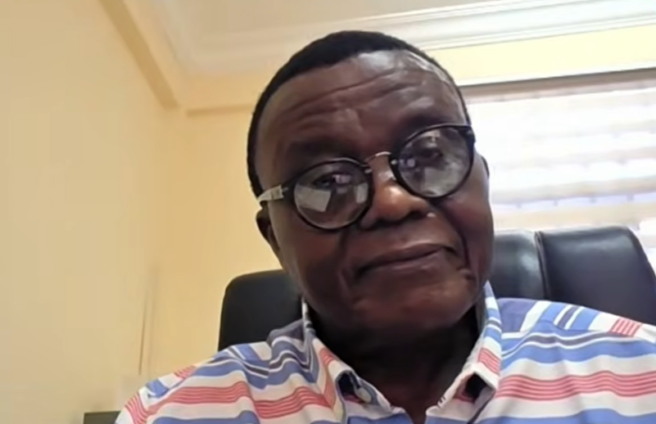
Political historian Prof. Baffour Agyeman-Duah has endorsed Sir Sam Jonah’s call for the restoration of the military rank of former Head of State General Ignatius Kutu Acheampong, arguing that the circumstances surrounding its withdrawal raise concerns about human rights and justice.

He said the appeal was not necessarily an endorsement of Acheampong’s administration but rather a call to reconsider the legality and fairness of the treatment he received following his removal from power and eventual execution in 1979.
Speaking on Channel One TV on Wednesday, November 18, Prof. Agyeman-Duah said he shared Sir Sam’s position that Acheampong’s military rank should not have been withdrawn in the manner it was, particularly considering his years of service in the Ghana Armed Forces.
He explained that Sir Sam’s argument centred on Acheampong’s contributions to the country, his military career and the circumstances surrounding his removal and death.
“His point is that, looking overall at the work of Acheampong and the restoration that occurred, and more importantly the fact that his vision and the efforts he made in really progressing this country, that for him, the way and manner that he was disposed of without any regard to law, according to him, was unjust,” he said.
He added that the withdrawal of Acheampong’s military title should also be examined within the broader context of the human rights violations he allegedly suffered.
“Therefore, the taking away of his title was unjust. So he places it in the context of human rights, the way he was treated and all that is the viewpoint of Sam Jonah, and I think in a way I can share that sentiment,” he stated.
Prof. Agyeman-Duah, whose book examines Acheampong’s life and administration, said the renewed debate presented an opportunity for Ghanaians to revisit the country’s political history and develop a more balanced understanding of the former military ruler.
He argued that historical assessments should acknowledge both the achievements and failures of past leaders rather than focus exclusively on either side of their records.
“We all look back at history and begin to discover new things. We discover certain things that are even worse than we thought, just as we discover some excellent things that we never knew,” he observed.
According to him, the discussions generated by Sir Sam’s lecture and his own research have helped bring previously overlooked aspects of Acheampong’s leadership and treatment into the national conversation.
“When I say that we are looking at the good, the bad and the ugly, I think that is exactly what I have done and that is what Sir Sam Jonah sought to do,” he added.
Sir Sam Jonah’s Call for Restoration
Sir Sam Jonah, Chancellor of the University of Cape Coast, made the appeal during the second General Ignatius Kutu Acheampong Public Lecture in Accra on November 13.
He called on President John Dramani Mahama, the Armed Forces Council and Parliament, where necessary, to restore Acheampong’s rank of General, reinstate his name on the rolls of the Ghana Military Academy and return to his family the honours associated with the rank.
Sir Sam argued that Acheampong, who served in the military for more than 20 years, was stripped of his rank through a decree before his execution by firing squad on June 16, 1979.
He maintained that restoring the former Head of State’s military rank would not amount to endorsing his political record but would instead address what he considers an injustice surrounding the circumstances of his removal and death.
A Controversial Legacy
Acheampong seized power on January 13, 1972, through a military coup that overthrew the elected government of Dr Kofi Busia. He subsequently headed the National Redemption Council and later the Supreme Military Council until he was removed from office in a palace coup on July 5, 1978.
His administration introduced several initiatives, including Operation Feed Yourself, which sought to boost domestic food production. His government also pursued policies in education, housing and the mining sector.
However, his tenure was equally characterised by economic difficulties, political repression and growing public dissatisfaction.
Following the June 4, 1979 uprising that brought the Armed Forces Revolutionary Council (AFRC) to power, Acheampong was executed on June 16, 1979.
Prof. Agyeman-Duah’s latest comments have added to growing calls for a reassessment of Acheampong’s place in Ghana’s political history, while renewing discussions about the distinction between recognising his military service and evaluating his record as a Head of State.


