


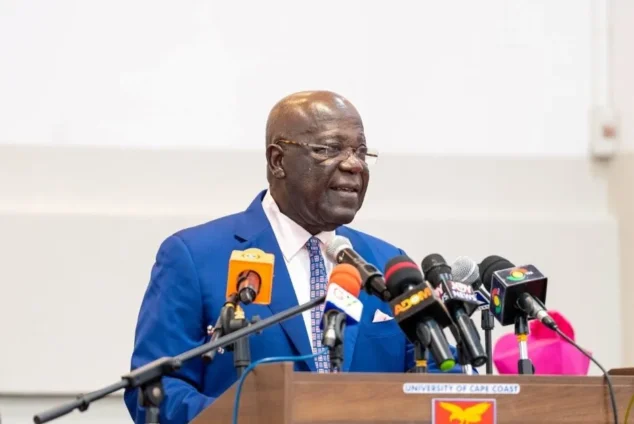
Business leader and Chancellor of the University of Cape Coast (UCC), Sir Sam Jonah, has called for a fundamental overhaul of Africa’s higher education system, warning that universities are producing graduates with academic qualifications but without the practical skills needed to drive economic transformation.

Speaking at the installation of Professor Denis Worlanyo Aheto as Vice-Chancellor of the University of Cape Coast on Saturday, August 1, Sir Sam said universities must redefine their purpose in an era where artificial intelligence (AI) can outperform humans in many knowledge-based tasks.
“I say this with love, but I must say it: too many of our graduates leave university having memorised much and built little,” he said.
Drawing on an analogy by education consultant Anis Haffar, Sir Sam explained that a student could excel in music theory yet be unable to play a simple tune on the flute, illustrating the disconnect between academic knowledge and practical ability.
“The world our graduates are entering will not ask them what they know. It will ask them what they can do.”
He argued that the challenge extends across Africa, where many graduates understand theoretical concepts but lack the competence to apply them in real-life situations.
“Multiply that flute by a million, and you have the tragedy of African education: graduates who can describe agriculture but cannot grow a tomato; who can define entrepreneurship but have never sold anything.”
According to Sir Sam, the continent’s education systems risk perpetuating poverty if they continue to prioritise knowledge acquisition over practical competence.
“Knowledge of a thing is not the ability to do the thing. And a nation of people who know, but cannot do, will remain a poor nation—beautifully certificated, and poor.”
AI changing the role of universities
Sir Sam said the rapid advancement of artificial intelligence has fundamentally altered the role of higher education, noting that information and answers are now readily available through technology.
“For the first time in human history, the cleverest entity in the room may not be a person. The scarcity of answers is over.”
He warned that universities would become increasingly irrelevant if they continued to define themselves solely as institutions that transmit knowledge.
“If our answer is: ‘to transmit knowledge’—then we are finished, because a machine now does that better, faster and cheaper than we ever will.”
Instead, he urged universities to focus on developing creativity, critical thinking, innovation and practical problem-solving skills—qualities he believes machines cannot replicate.
“But if our answer is: ‘to form human beings who can do what no machine can do’—then, ladies and gentlemen, the university is about to enter its greatest century.”
Call for vocational and industry-focused education
Rejecting the notion of “useless degrees,” Sir Sam argued that the real problem is the disconnect between academic programmes and practical application.
“There are no useless degrees. There are only degrees that have been separated from usefulness—and it is our job to reunite them.”
He proposed that the University of Cape Coast become the first university in Africa to establish a degree-awarding faculty dedicated to vocational education, where students would graduate only after demonstrating real-world competence.
Sir Sam also called for expanded project-based learning, stronger partnerships between universities and industry, and the integration of artificial intelligence into every academic discipline.
“The certificate and the competence, reunited at last.”
Concluding his address, he challenged universities across Africa to produce graduates capable of creating value and solving real-world problems rather than merely collecting academic credentials.
“The universities that answer this call will produce the founders, the builders, and the leaders of the coming decades. The universities that do not will produce certificates.”


