


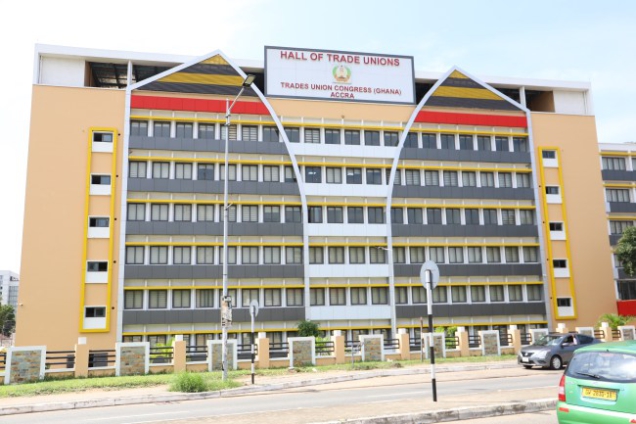
The Deputy Secretary-General of the Trades Union Congress Ghana, Kwabena Nyarko Otoo, has criticised claims that government borrowing is primarily used to pay public sector wages, describing the narrative as misleading and unfair to workers.

Speaking on Newsfile on March 21, Dr. Otoo argued that the framing of government expenditure has been skewed in a way that unfairly casts public sector employees as responsible for the country’s fiscal challenges.
He rejected the assertion that salaries are the main driver of borrowing, emphasising that wage payments are a statutory obligation that government must fulfil.
“This idea that government is borrowing to pay salaries is quite unfair to labour,” he said. “The narrative could equally be that after paying salaries and statutory transfers, government had to borrow to service its debts.”
Dr. Otoo questioned why public discourse often places blame on workers rather than addressing broader structural pressures, including debt servicing.
He also highlighted what he described as significant restraint by organised labour during recent wage negotiations. According to him, in 2025, when inflation was close to 24 percent, unions accepted a 10 percent salary increase following appeals from John Dramani Mahama.
“Government presented the economic situation to us, and the President himself pleaded that conditions were not favourable,” he explained. “We accepted 10 percent, even though inflation was much higher, and our members were not happy.”
Dr. Otoo added that labour made further concessions in 2026, agreeing to a 9 percent wage increase after government cited competing fiscal priorities, including the need to recruit newly trained teachers and nurses.
“They told us they needed to bring more young people into employment, particularly those graduating from training colleges,” he said. “On that basis, we accepted 9 percent.”
Despite these compromises, he expressed concern about what he described as a growing narrative that public sector wages consume the bulk of government resources. He said organised labour disputes some of the figures used to support this claim, arguing that they do not accurately reflect the full state of public finances.
“Now we are being told that nearly everything is going into compensation,” he said. “We strongly refute some of these figures.”
Dr. Otoo maintained that public sector workers are being unfairly blamed for economic difficulties, despite their willingness to make sacrifices during challenging periods.
He warned that such narratives risk undermining morale and misinforming the public about the real drivers of Ghana’s fiscal pressures, calling for a more balanced and transparent conversation on government spending priorities.


