


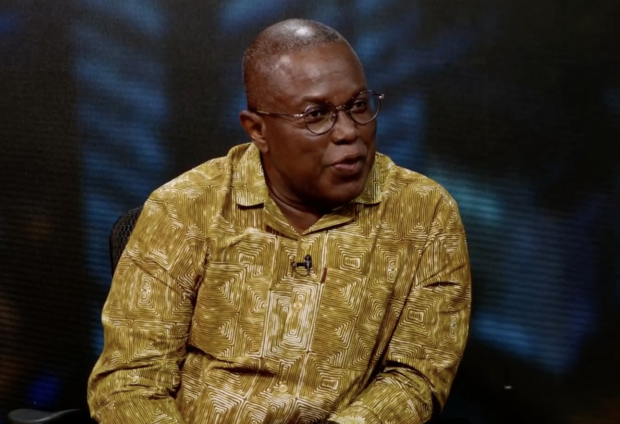
The Chairman of the National Development Planning Committee (NDPC), Dr Nii Moi Thompson, has revealed that the government’s flagship 24-Hour Economy Programme was conceived from Ghana’s 48-year Development Plan.

According to him, the 24-hour economy is among the key initiatives that emerged from the long-term development framework, even though the broader plan was never legislated.
Speaking on Joy News’ PM Express on Wednesday, Dr Thompson said the National Democratic Congress (NDC) adopted the initiative from the development plan.
“Actually, the 24-hour economy came from the 48 Development Plan. It’s one of the few things that have actually come out of it,” he said.
He explained that although the 48-year Development Plan was intended to serve as a comprehensive framework for Ghana’s long-term development, it was not enacted into law.
“But the 48 Development Plan, as in its entirety, should have been legislated, but it wasn’t. But the government, the NDC, removed that from the 48 Development Plan. So the 24-hour economy actually came from the 48 development plan,” he said.
Other initiatives linked to the plan
Dr Thompson said several other government initiatives and institutional reforms also originated from the long-term development framework.
He cited the naming of the Ministry of Sports and Recreation as one such initiative.
“The name of the Ministry of Sports and Recreation came from the 48 Development Plan,” he said.
He also mentioned the proposed Ghana Agency for Development Cooperation, which he said is currently being developed by the NDPC in collaboration with the Ministry of Foreign Affairs.
“We have something known as the Ghana Agency for Development Cooperation, which is currently being developed between NDPs and the Ministry of Foreign Affairs, to help form soft power for Ghana and Global Affairs,” he said.
Focus on SMEs
Assessing the implementation of the 24-hour economy, Dr Thompson said significant progress had been made, particularly in attracting investments across various sectors and business categories.
“From the perspective of those who came up with the idea, I think they’ve done pretty well. You have to understand that they are operating across a spectrum of businesses, from small to large,” he said.
He noted, however, that large-scale investments often require considerable time before they begin generating significant returns.
“Usually, it takes the gestation period for big businesses take a while to get, and I think they put a lot of effort into it. They’ve lined up a lot of investments. It will take a while for those to catch on,” he said.
Dr Thompson said the programme should place greater emphasis on small and medium-sized enterprises (SMEs) over the next two years to ensure that its benefits reach businesses across the economic spectrum.
“My expectation is that in the next two years, they will focus more on the SMEs also, so that you cover the whole spectrum,” he said.
Job creation and quality employment
The NDPC Chairman further stressed the importance of job creation as a central component of the 24-hour economy.
He said existing businesses have a significant role to play in generating new employment opportunities and indicated that efforts were underway to address that aspect of the programme.
“From our understanding, there are efforts on the way to handle that aspect of it,” he said.
Beyond creating new jobs, Dr Thompson said government must also tackle underemployment and improve the quality of existing jobs.
“The issue of dealing with the quality of existing jobs is one of those legs that I expect them to work on in the next two years,” he said.
He said addressing unemployment, underemployment and poor-quality jobs would be essential to ensuring that the 24-hour economy delivers meaningful and sustainable benefits to Ghanaians.


