


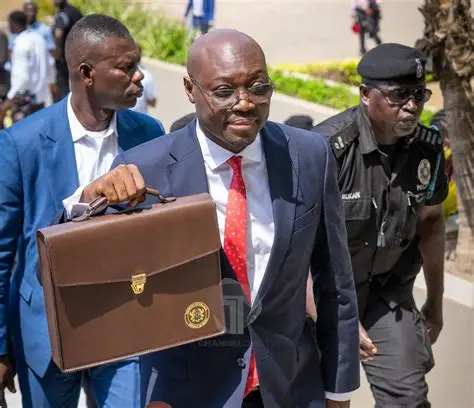

By: Gottlieb Baako
As Finance Minister Dr. Cassiel Ato Forson has presented the 2026 Mid-Year Budget Review to Parliament on July 23, 2026, national economic stakeholders, international investors, and business leaders are turning their full attention to Ghana’s fiscal policy trajectory.
Originally introduced as a ambitious GH¢357 billion budget statement themed “Resetting for Growth, Jobs, and Economic Transformation,” this mid-year evaluation serves as the first major test of performance six months into the implementation cycle.
Rather than acting as a mere technical reporting exercise, the upcoming address before lawmakers will outline the government’s operational strategy to reconcile revenue performance, sustain debt sustainability, and accelerate real-sector growth in a crucial post-stabilization period.
At the top of the legislative agenda is a rigorous assessment of domestic revenue mobilization against expenditure realities.
The 2026 economic blueprint targeted total commitment revenue and grants of GH¢268.1 billion against projected commitment expenditure of GH¢302.5 billion, establishing an overall fiscal deficit target of 2.2 percent of GDP alongside a primary surplus target of at least 1.5 percent of GDP.
As the Ministry of Finance presents first-half fiscal results, Parliament will closely examine whether the Ghana Revenue Authority’s digital tax compliance systems, VAT administration reforms, and non-tax revenue collections are keeping pace with statutory obligations.
The Finance Minister must demonstrate how the state plans to protect its primary surplus without resorting to unbudgeted borrowing or imposing disruptive emergency levies that could stifle emerging private enterprise.
Expenditure control and systemic efficiency form another decisive front in the upcoming mid-year review.
Having institutionalized measures to cap non-essential operational spending, restrict foreign travel, and eliminate low-impact programs, the Ministry of Finance is under pressure to prove that cost-containment directives are generating measurable liquidity savings across Ministries, Departments, and Agencies.
Simultaneously, civil society and business associations are watching how the state balances expenditure cuts with its commitment to protect priority capital investments.
Key flagship growth drivers—most notably the GH¢30 billion Big Push infrastructure program, energy reliability interventions, agribusiness support, and the 24-Hour Economy framework—require steady, unhindered capital disbursements to expand productive capacity and generate decent employment for the youth.
Furthermore, the mid-year review comes at a time when Ghana is reinforcing its policy credibility beyond intensive international assistance mechanisms.
With key macroeconomic indicators pointing toward single-digit inflation targets, domestic yield stabilization, and a strengthened exchange rate environment, the presentation must reassure domestic and foreign capital markets that structural reforms remain permanently anchored.
Lawmakers will scrutinize the status of legislative proposals, including comprehensive reviews of the Income Tax and Value Added Tax frameworks, designed to simplify tax structures, eliminate compliance inconsistencies, and align Ghana’s regulatory framework with international standards.
Ultimately, the 2026 Mid-Year Budget Review will test the government’s ability to turn macroeconomic stabilization into tangible economic opportunity.
As Dr. Ato Forson steps onto the floor of Parliament on July 23, the burden will be on the executive to present an unvarnished report of first-half performance, outline precise fiscal adjustments, and deliver a convincing blueprint that maintains fiscal discipline while keeping the national economy firmly on course toward long-term transformation.


