


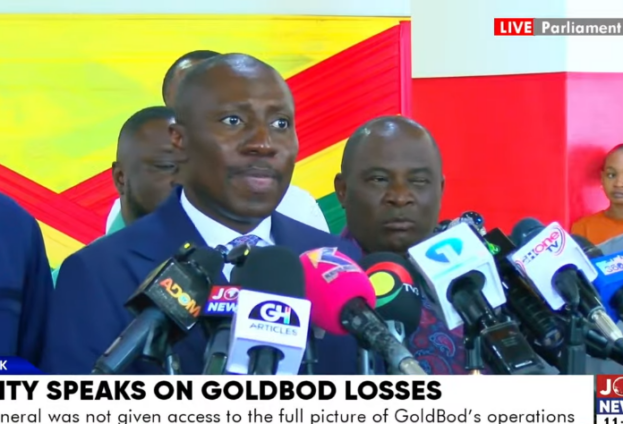
Minority Leader and Effutu MP Alexander Afenyo-Markin has challenged the Ghana Gold Board (GoldBod) to explain the financial arrangements underpinning its gold purchasing and trading operations.

He argued that GoldBod should account for both the revenues generated from transactions and the costs and risks associated with them, rather than benefiting from transaction-related fees while losses remain with the Bank of Ghana (BoG).
Speaking at a press conference in Parliament on Tuesday, August 18, Mr Afenyo-Markin said the Minority’s concerns were motivated by the need to protect the public interest and were not intended as personal attacks on GoldBod officials.
“You don’t get to keep the fees and disown the costs,” he said.
Questions over gold programme losses
Mr Afenyo-Markin’s comments follow findings in an International Monetary Fund (IMF) report on Ghana concerning losses incurred under the Bank of Ghana’s Domestic Gold Purchase Programme, which is implemented through GoldBod.
According to the IMF, the significant expansion of the programme in 2025 resulted in losses exceeding US$1.7 billion, equivalent to approximately 1.5% of Ghana’s GDP.
The Minority Leader questioned the circumstances surrounding the sale of gold to off-takers at discounted prices and called on GoldBod to disclose the identities of the buyers and explain the fee arrangements associated with the transactions.
He stressed that the Minority’s concerns were based on information contained in the IMF report rather than figures produced by the opposition.
Who bears the financial risk?
Mr Afenyo-Markin also questioned why losses associated with gold purchases, pricing and sales decisions should remain on the Bank of Ghana’s balance sheet while GoldBod receives credit for revenue and foreign exchange generated through the programme.
He argued that the public deserved greater transparency regarding the structure of the transactions, the discounts offered to off-takers and the parties that ultimately benefited from the gold sales.
According to him, GoldBod must provide clear explanations of how the programme’s financial risks and returns are allocated among the institutions involved.
The Minority Leader maintained that losses arising from Ghana’s gold trading operations should not simply be transferred to the central bank and, ultimately, the taxpayer.
Minority demands accountability
Mr Afenyo-Markin said the issues require thorough scrutiny to establish how the gold purchasing and trading arrangements operate and who bears responsibility for the associated costs.
His comments form part of an escalating dispute between the Minority and GoldBod over the financial performance, management and transparency of Ghana’s gold trading operations.
The Minority is demanding greater disclosure of the programme’s transactions and financial arrangements, particularly in light of the losses identified by the IMF.


