


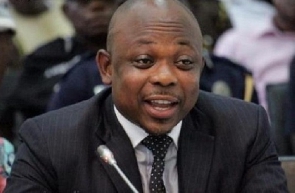
Incoming Majority Leader James Agalga has called for a comprehensive investigation into Ghana’s Domestic Gold Purchase Programme, arguing that any probe limited to GoldBod’s operations in 2025 would provide an incomplete account of the scheme.

Speaking on PM Express on Monday, the Builsa North Member of Parliament said Parliament must examine the programme from its inception in 2021 and scrutinise how domestic gold purchases were conducted under previous administrations.
“You want us to interrogate matters properly; you do a holistic investigation,” Mr Agalga said.
He questioned the rationale for restricting the investigation to 2025, particularly because an agreement between the then Precious Minerals Marketing Company (PMMC) and the Bank of Ghana remains in force.
Mr Agalga said he had copies of an agreement dating to 2023 which, according to him, had not been terminated. He warned that excluding the earlier period could prevent Parliament from obtaining a complete understanding of the financial arrangements underpinning domestic gold purchases.
“If you limit your investigation, when in actual fact we are talking about an agreement which is still in force … and you limit the scope to only 2025, you’ll be doing a grave disservice to the people of this country,” he said.
Questions over gold purchase rates
The legislator also urged Parliament to establish how costs associated with gold purchases were handled during the earlier stages of the programme and whether similar practices continue under the current arrangement.
In particular, he questioned whether PMMC purchased dore gold in 2021 using foreign-exchange bureau rates rather than the Bank of Ghana’s official rates.
“Is it the case that at that time, 2021, the Precious Minerals Marketing Company bought the dore … using forex bureau rates as opposed to the Bank of Ghana rate?” he asked.
Mr Agalga said any difference between the two rates could have resulted in additional costs or losses and therefore needed to be investigated.
“So, who bears the costs associated with those differentials?” he asked, adding that Parliament needed to determine whether the practice existed previously and whether it remains in use.
Agalga defends GoldBod
Mr Agalga also rejected claims that the Ghana Gold Board, commonly known as GoldBod, had incurred losses through its operations.
He said documents he had reviewed showed that GoldBod was prepared to subject its operations to scrutiny and had nothing to hide.
“I can tell you on authority that the Gold Board will relish any opportunity created for the issues that have come up over the period to be interrogated. So, they are ready. They are not running away from accountability,” he said.
According to Mr Agalga, the Auditor-General’s 2025 report contained no adverse findings against GoldBod.
“You have an Auditor-General’s report dated 2025. No single adverse finding in that report was made against the Gold Board,” he said.
Who bears the cost?
Mr Agalga further pointed to the agreement between PMMC and the Bank of Ghana, which he said addresses costs associated with domestic gold purchases.
These costs, he explained, include security, insurance, assaying and smelting.
He argued that GoldBod, as an agent of the Bank of Ghana, should not be regarded as the entity responsible for those costs.
“The principal must pay the cost. Gold Board itself has never incurred losses. On the contrary, they have made a surplus, huge, in the region of what, 4 billion plus, thereabout, and that is captured in the Auditor-General’s report,” he said.
Mr Agalga maintained that Parliament’s investigation should therefore extend beyond the operations of GoldBod in 2025 and examine the entire history and financial structure of the Domestic Gold Purchase Programme.
“So let us bring all the issues to the fore, investigate the matters thoroughly, and whatever findings we make, the people of this country can be properly guided,” he said.


