


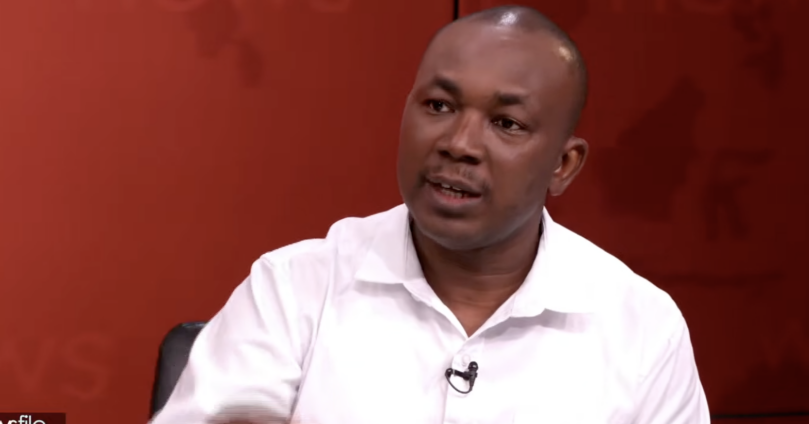
Economist Professor Godfred Bokpin has cautioned Ghana against becoming overly dependent on gold to sustain economic stability, warning that the country could be exchanging long-term economic and environmental security for temporary gains.

Speaking on the Joy FM Super Morning Show on Monday, August 24, Professor Bokpin argued that the enthusiasm surrounding gold’s contribution to foreign exchange earnings, reserves and macroeconomic stability was overshadowing the potentially devastating consequences of irresponsible mining.
He said Ghana’s current economic position remains vulnerable because it is heavily exposed to movements in international gold prices.
According to him, a sharp correction in gold prices could quickly erode the gains being celebrated and expose the weaknesses of an economy that has become increasingly reliant on the commodity.
Professor Bokpin said a decline of more than 40 per cent in global gold prices could cause the current macroeconomic gains to disappear within months.
He therefore urged policymakers to conduct comprehensive sensitivity analyses and stress tests to determine how resilient the economy would be under a major decline in gold prices.
The economist also cautioned that Ghana must take lessons from historical commodity cycles, noting that periods of rapid price increases have frequently been followed by significant corrections.
Environmental costs being ignored
Professor Bokpin argued that the debate over Ghana’s gold economy should not be limited to foreign exchange inflows and other conventional economic indicators.
He called for a broader assessment that captures the environmental, social and economic costs associated with gold production, particularly the destruction of water bodies and ecosystems through irresponsible mining.
He said Ghana should adopt a value-chain approach that incorporates what he described as the “environmental subsidy” associated with gold production.
According to him, the country cannot accurately determine whether it is benefiting from its gold resources without accounting for the ecological damage created in the process.
“If you put all of these things together, through the analysis, and you’re able to say that we are far better off, then that’s good news,” he said.
However, Professor Bokpin was unequivocal in his assessment of Ghana’s current situation.
“We are not better off,” he stated.
He described the willingness to tolerate extensive environmental destruction in the name of macroeconomic stability as a failure of leadership, arguing that the consequences would ultimately be borne by future generations.
Call for a new economic model
Professor Bokpin also challenged Ghana to move away from an economic model that depends heavily on the extraction and export of primary commodities.
He argued that a development strategy built around environmentally destructive activities cannot provide sustainable prosperity, particularly when the country remains vulnerable to external commodity price shocks.
He cited Malaysia as an example of a country that successfully transformed its economy after reducing its dependence on primary commodities.
According to Professor Bokpin, Malaysia’s economy was once heavily dependent on commodities such as tin and copper, but the country gradually shifted towards a more diversified economic structure from the 1970s onward.
He said Ghana should pursue a similar transition by investing in sectors capable of generating sustainable economic value without placing the country’s natural resources under severe pressure.
Questioning the limits of GDP
Professor Bokpin further questioned whether Ghana’s reliance on Gross Domestic Product (GDP) as a measure of economic progress adequately reflects the consequences of irresponsible mining.
While mining activity contributes to GDP, he argued that the destruction of water bodies, ecological systems and livelihoods is not sufficiently captured in conventional economic measurements.
“How do we celebrate such a growth model with a huge environmental footprint?” he asked.
He cited the longstanding criticism that GDP can present an incomplete picture of economic wellbeing, particularly when environmental and social costs are excluded from the calculation.
For Professor Bokpin, the debate ultimately extends beyond economic statistics to the value placed on human life and the country’s natural resources.
He questioned whether improved macroeconomic indicators could genuinely be considered a gain if they were achieved at the expense of lives, clean water and environmental security.
His warning comes amid heightened national debate over Ghana’s gold sector, the role of the Ghana Gold Board and the economic benefits of gold purchasing, as concerns over illegal and environmentally destructive mining continue to dominate public discourse.


