


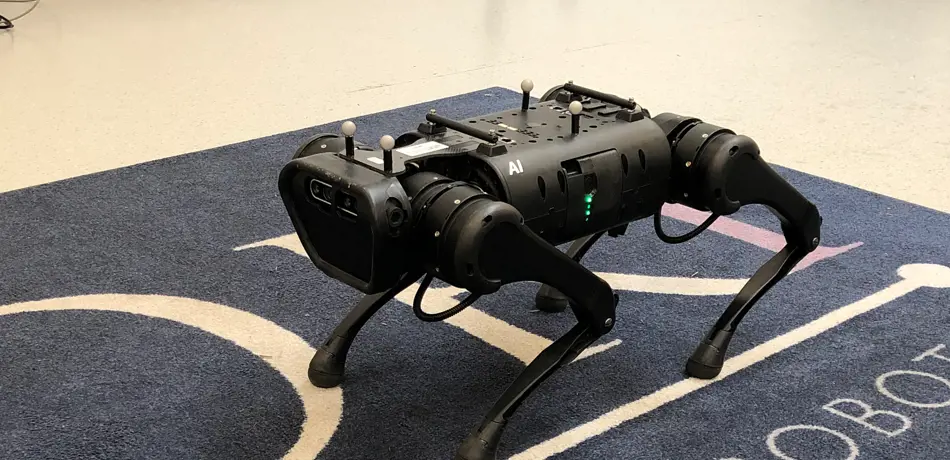
Robots for training carers, sensors that monitor people as they sleep and an app that can detect if someone is in pain – could this be the future of care?

The care sector is increasingly using technology and Artificial Intelligence (AI) to look after the UK’s ever-growing elderly population.
Despite this, experts have urged people to consider the potential risks of an overreliance on AI in the industry.
“AI can only be part of the solution but not the whole solution,” says Dr Caroline Green from the University of Oxford.
Dr Green, the director of research at the Institute for Ethics in AI, spoke at an AI in Social Care Summit at the university in March.
She highlighted how AI systems could be susceptible to biases, which amplify discrimination, prejudice and stereotyping and has also recognised the worries people have around sharing their personal data with the technology.
“At the moment there’s no official government policy on guidance on the use of AI in social care,” Dr Green added.
She said: “Whether it’s going to be good for people who need support, depends on how policy is going to shape up here, it depends on what choices people will continue to have in the future, or whether they can for example opt out of having AI in their care at all, it will depend on whether there is going to be a sense in which AI technology can take over care provision and human interaction.
“We need to be very careful here on what choices people will have in the future and what the future of social care with AI will look like.”
Fall reduction
Thomas Tredinnick is the boss of AllyCares that uses sensors to monitor care home residents’ rooms overnight, listening out for anything out of the ordinary.
It sends an audio recording of any incidents to carers on shift, who can then decide how to act.
Speaking from Oaklands Rest Home in Southampton, which uses the technology, Mr Tredinnick said it saves staff having to perform regular nightly checks, meaning residents can get a better sleep.
“The care staff are providing care to the residents that need it,” he said. He claims it has helped to reduce preventable health events leading to hospital admissions, as it spots things like falls and chest infections before they escalate.
Christine Herbert said her 99-year-old mother Betty is one of the residents being monitored by the technology.
She admitted she was uncertain about the use of AI at first, comparing the technology to a “baby monitor”.
“When mum came here for the first few nights I did ask for routine checks because I was concerned,” she said.
Mrs Herbert said she came around to the technology after the home presented her with data which showed how her mother was monitored and not disturbed during the night.
App for pain
At Elmbrook Court care home in Wantage, Oxfordshire, they are using AI to find out if residents are in pain.
Aislinn Mullee, deputy manager at the home, said: “It can be quite difficult to identify pain in a resident that is non-verbal.”
Using a smartphone app called Painchek, carers scan a resident’s face for pain indicators, answer questions about the resident and then receive an instant percentage score which indicates the level of pain that person is feeling.
Ms Mullee said it has made a “huge difference” and they have used the information in collaboration with local GPs to assess which pain medication a resident requires.
She added it has also been used to reassure family members that a loved one receiving end-of-life care was not in pain.
Ms Mullee made clear the data gathered was password-protected and only visible to staff at the home. Robot training
At the University of Oxford’s Robotics Institute they are hoping AI could also be used to train carers.
Dr Marco Pontin, a Post Doctoral Research Assistant, is part of a team which has created a robot which reacts to human touch.
It can be programmed to feel pain in different parts of its body and will physically flinch if a carer is too forceful when touching a painful area.
It will be trialled with students studying to be occupational therapists at Oxford Brookes University. Dr Pontin said the team hoped to use it as a “digital twin” of real life patients.
It will be programmed with the same conditions as a human patient so that carers “can replicate whatever they have seen in the real world but with the robot counterpart”.
He said: “With an ever-growing ageing population it’s harder to be there for everyone, so providing a digital twin of a patient could enable occupational therapists to know what is going on with their various patients without necessarily being there all of the time.”
Care challenges
People are living longer and there are an estimated 12 million people in the UK aged 67 or over, with that figure projected to rise to 13.7m by 2032.
A report published by the House of Commons library in March stated in 2023/24, local authorities in England spent £23.3bn on adult social care, which was the second biggest area of council spending after education.
The sector’s reliance on workers from overseas is another big issue.
Home Office statistics showed 27,000 visas were issued to people coming to the UK to work in health and social care, in the 12 months to December 2024.
This was a fall of 81% compared with the previous 12 months. The number coming to work in the sector had increased significantly after temporary changes to the health and care visa rules.
“We’re reliant on migrant workers to keep social care going at the moment,” says Lee-Ann Fenge, professor of social care at Bournemouth University.
She said she does not believe new technology should be used as a way of filling the gaps in the sector.
She said “It needs to be seen as a tool that enhances the work that is already happening.”
She added time needed to be taken to “think about some of the ethical challenges” that monitoring people could have.
“We need to prepare people better to protect themselves, so this isn’t just about saying AI is wonderful, let’s use it. We need to look at both the potentials of AI but also the risks that it could pose,” she said. In February, the UK and US governments refused to sign an international AI declaration in Paris, which pledged an “open”, “inclusive” and “ethical” approach to the technology’s development.
This comes as the government announced in March it will take a “test and learn” approach to funding AI in the public sector, in order to “push innovation”.
When catching up with Dr Caroline Green again she continues to promote a cautious approach to AI.
“It can help with some of the administrative work, some of the operation of care, but it cannot replace that human touch,” she said.
“There is a potential risk that AI is going to be seen as a panacea to some of those very big problems that we are seeing in social care provision, namely that we don’t have enough staff, and that there is a growing demand from an ageing population.
“I think here we really need to make sure that we don’t just invest in AI to take over care-giving but that we keep on investing in people, in professionals who will be able to provide that care.”
A Department of Health and Social Care (DHSC) spokesperson said: “We will harness cutting-edge technology to transform social care and we are already seeing promising developments across the sector – from AI-powered fall detection systems that provide earlier interventions, to tools which automate paperwork to free up staff to focus on caring for people.
“Making better use of AI in social care is exactly the kind of transformation we’re championing in our 10 Year Health Plan – shifting from treating sickness to preventing it, from hospital to community care, and from analogue to digital solutions.”–BBC


