


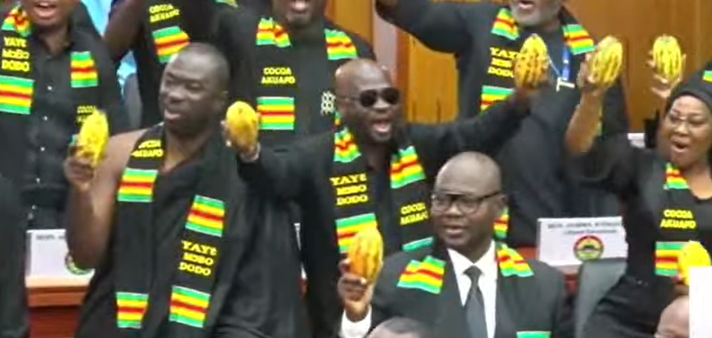
Parliament’s chamber turned theatrical on Friday, February 28, when cocoa pods — not policy papers — became the centrepiece of a dramatic political standoff moments before the President’s State of the Nation Address.

The charged atmosphere unfolded shortly after Speaker Alban Bagbin invited President John Dramani Mahama to address the House.
Before the speech could begin, Majority Members broke into song, chanting in Twi: “Ɔde asɛmpa na aba oo, Ɔde asɛmpa na aba ooo” — “He has brought good news.” The chorus echoed across the chamber, punctuated with references to the government’s flagship “24-Hour Economy” policy, which it says will boost productivity and drive growth.
But the Minority was not in a celebratory mood.
In swift response, opposition MPs countered with their own variation of the chant, altering the final line to “atɔ nsuom” — “it has fallen into water,” a phrase often used to signal failure. Then came the visual statement that stole the spotlight: cocoa pods raised high inside the chamber.
The gesture was deliberate.
Cocoa remains one of Ghana’s most vital export commodities, sustaining hundreds of thousands of farming households and serving as a key source of foreign exchange. By bringing the pods into Parliament, the Minority sought to spotlight what it describes as a deepening crisis in the cocoa sector — marked by declining production, financial strain and wider economic ripple effects.
The symbolism was unmistakable. While the Majority’s harmonies framed the President’s address as an announcement of hope and recovery, the cocoa pods told a different story — one of concern and unfinished business in a cornerstone sector of the economy.
In a chamber often defined by speeches and statistics, it was the quiet weight of cocoa — Ghana’s historic “brown gold” — that carried the loudest message.


