


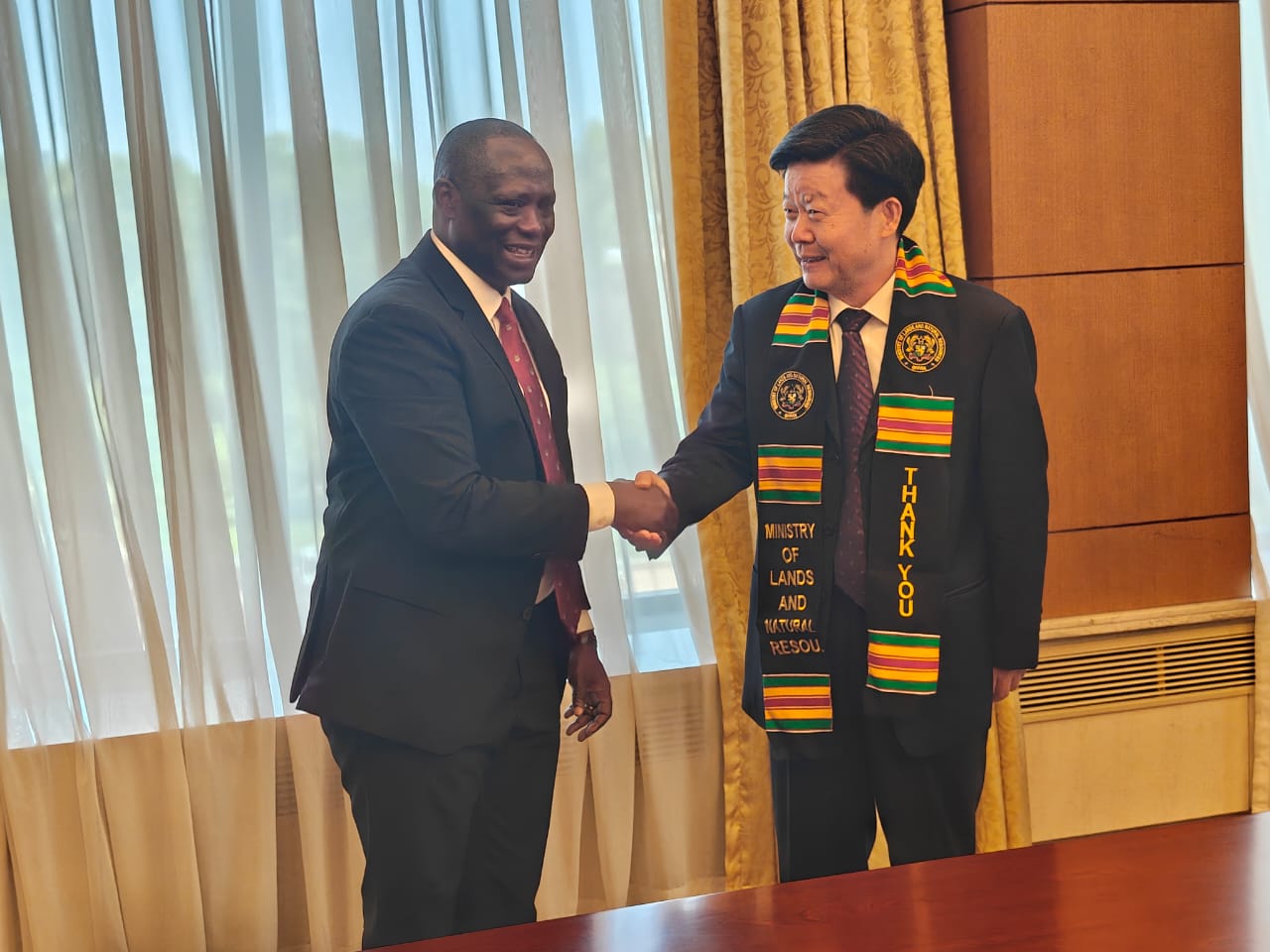
Ghana and China have agreed on a new three-point plan to crack down on illegal mining, boost geological mapping and drive responsible investment in Ghana’s mining sector.

The breakthrough agreement was reached at a high-level meeting between Ghana’s Minister for Lands and Natural Resources, Emmanuel Armah-Kofi Buah, and China’s Deputy Minister of Natural Resources, Sun Shuxian, on the sidelines of the 2026 China Mining Conference in Tianjin.
Mr. Armah-Kofi Buah, who led the Ghanaian delegation with Ghana’s Ambassador to China, Kojo Bonsu, said the deal marks the first direct engagement between the two countries on mining regulation in five years.
“This is very important in how we collaborate on critical areas of the natural resources sector. This includes how to work with them in policing Chinese companies that are working in Ghana to make sure that they meet the highest standards,” he said.
At the heart of the deal is a joint crackdown on illegal mining, locally known as galamsey. Under the arrangement, Chinese nationals caught engaging in illegal mining in Ghana will face sanctions in both countries.
“Those who are found to have broken the law, especially those who engage in illegal mining activities (galamsey), are not only punished in Ghana, but we have a pathway where the Chinese will also police their people who are working in Ghana,” the Minister stressed.
The strategy also focuses on strengthening the Ghana Geological Survey Authority, promoting green mining technology, environmental protection and technology transfer.
“We are also collaborating with them on green mining technology, environmental protection and technology transfer. Critically, we will be working with them on geological surveys and mapping. These are very critical breakthroughs,” Mr. Buah noted.
To ensure implementation, both countries have agreed to set up a joint technical team. The Minister thanked Ambassador Kojo Bonsu for facilitating the engagement.
On his part, China’s Deputy Minister Sun Shuxian pledged Beijing’s full technical backing for Ghana. “We are ready with you, and our proposal is that we suggest more collaboration on the Geological Survey and technological innovation. I suggest that we can together work on geological mapping and the critical mineral resources potential assessment of the key metallogenic belts,” he said.
Mr. Sun said China will support Ghana with satellite remote sensing, airborne geophysical surveys and other tools to bridge gaps in geological data, particularly in unmapped areas.He also proposed the establishment of joint laboratories for prospecting gold, lithium and other critical minerals, plus annual personnel exchanges and joint field training.
“The China Geological Survey would be tasked with following up on the proposed technical cooperation,” he said, adding that China’s Department of International Cooperation will serve as the focal point.
“I’m happy that you have identified a focal person to follow up on our collaboration so that our meeting would not just be about talking but walking the talk,” he stated.
Mr. Sun further proposed a permanent dialogue mechanism on sustainable mining, development of the mineral value chain and intelligent mining, and invited the Ghanaian delegation to Beijing for follow-up talks.
“Our meeting today is constructive and very in-depth, so we hope in the future we can have a win-win collaboration based on a high-quality partnership,” he said.
The Chinese delegation also shared its experience in rehabilitating degraded mine sites, revealing that China spends about one billion yuan annually on reclaiming abandoned pits under strict environmental standards.
“I’m happy to hear that you emphasised the importance of the development of green mining, because that is what China is doing now. In this process, we have accumulated some good practices and experiences. So we very much would like to share these experiences and practices with our Ghanaian friends,” Mr. Sun said.
The meeting was attended by the CEO of the Minerals Commission, Isaac Tandoh, Director-General of the Ghana Geological Survey Authority, Dr. Prosper Aduah Akaba, and CEO of GIISDEC, Williams Okofo Dartey.


