


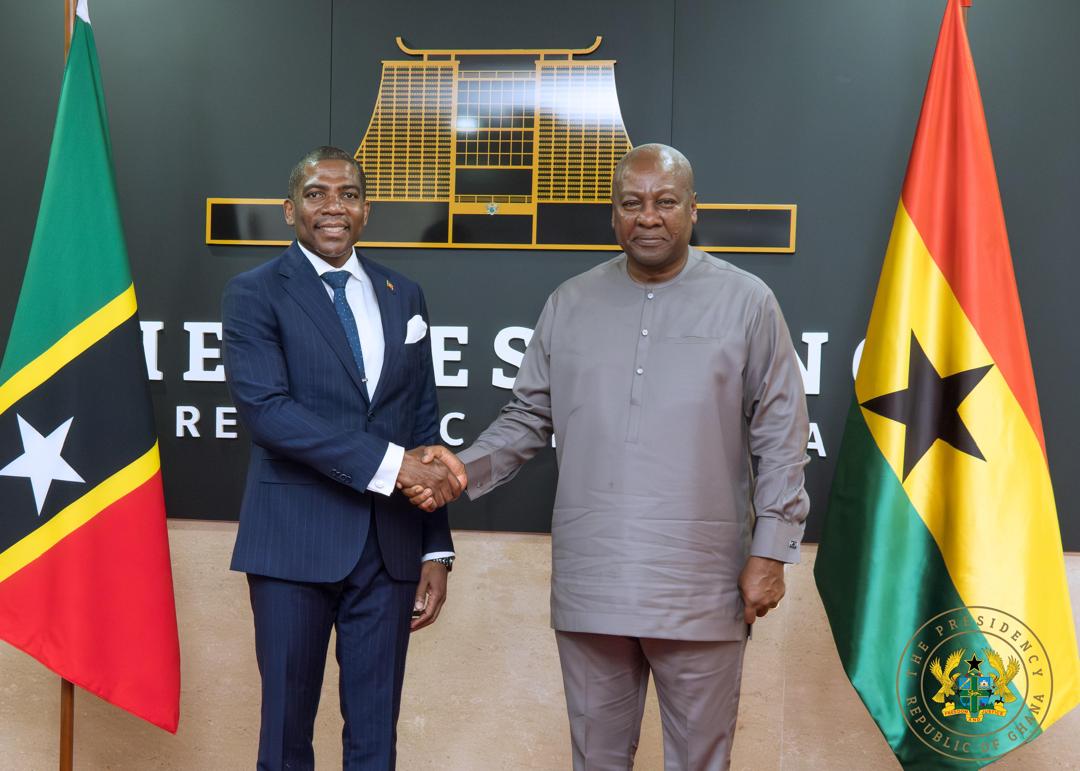
Ghana and St Kitts and Nevis have expanded their bilateral relations with the signing of a visa exemption agreement for holders of ordinary passports, alongside a separate labour mobility deal aimed at deploying Ghanaian medical professionals to the Caribbean nation.

The agreements were formalised on Wednesday at the Jubilee House in Accra by President John Dramani Mahama and Prime Minister Dr Terrance Michael Drew, who is in Ghana on a four-day State Visit.
Until now, visa-free travel between the two countries applied only to holders of diplomatic and service passports under a 2018 arrangement.
The newly signed Memorandum of Understanding extends that waiver to ordinary passport holders, significantly broadening access for citizens of both nations.
Addressing guests after the signing ceremony, President Mahama described the move as a decisive step toward strengthening cooperation.
He said expanding the visa waiver would ease travel restrictions and unlock new opportunities in tourism, trade and business exchanges, while also deepening people-to-people connections.
The President noted that beyond facilitating mobility, both governments have agreed to continue discussions on structured labour mobility frameworks.
He indicated that Ghana stands ready to support St Kitts and Nevis with skilled professionals — including nurses, teachers and other technical experts — under arrangements that ensure mutual benefit.
The accompanying Bilateral Labour Agreement is expected to pave the way for the recruitment of Ghanaian medical professionals to support healthcare delivery in St Kitts and Nevis.
President Mahama further disclosed that Ghana and the Caribbean nation have outlined additional sectors for collaboration.
These include tourism development, climate-resilient agriculture, renewable energy, blue economy initiatives, heritage promotion and the growth of cultural industries.
The twin agreements signal a deepening of South-South cooperation between Ghana and St Kitts and Nevis, positioning both countries to leverage mobility, trade and technical exchange as tools for shared development.


