


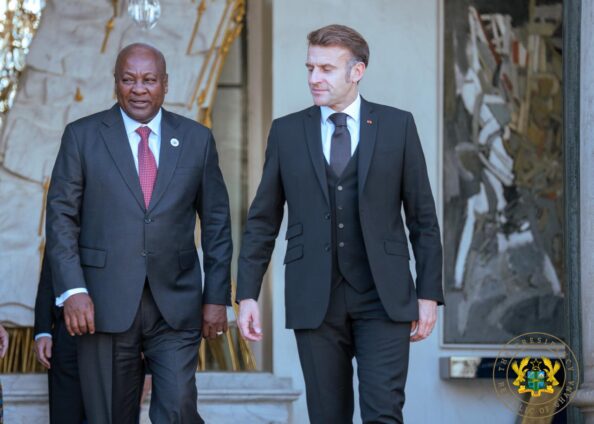
The Government of Ghana has welcomed what it described as a “historic and courageous” decision by France to engage in reparatory justice discussions concerning the transatlantic enslavement of Africans following recent policy announcements by French President Emmanuel Macron.

In a statement issued by Ghana’s Ministry of Foreign Affairs on Friday, May 23, 2026, the government praised President Macron for demonstrating what it called “honest, open, conciliatory and exemplary leadership” in addressing one of history’s most painful injustices affecting the global Black community.
The statement follows President Macron’s remarks during commemorations marking the 25th anniversary of France’s law recognising slavery as a crime against humanity. During the event, the French leader announced new anti-slavery measures and expressed readiness to work with Ghana on reparatory justice initiatives.
According to the government, the development marks a significant milestone in the growing international movement seeking acknowledgement, reconciliation and redress for centuries of transatlantic slavery and colonial exploitation.
Ghana-France Collaboration
The Ministry of Foreign Affairs stated that Ghana looks forward to strengthening cooperation with France through a proposed Ghana-France Scientific Commission expected to be established in Ghana.
The commission is expected to support scholarly research, historical documentation and institutional collaboration on matters relating to slavery, reparatory justice and historical accountability.
President John Dramani Mahama, who currently serves as the African Union Champion on Reparatory Justice, also expressed appreciation to President Macron for accepting an invitation to participate in the upcoming “Next Steps” High-Level Conference on Reparatory Justice scheduled to take place in Accra from June 17 to June 19, 2026.
The summit is expected to bring together Heads of State, diplomats, ministers, academics, civil society organisations and reparatory justice advocates from Africa, the Caribbean, Europe and the Americas.
Government officials say the conference aims to move global conversations on reparations beyond symbolic acknowledgement toward concrete policy frameworks and sustained international cooperation.
UN Resolution
The ministry also noted that the recent developments follow the adoption of a Ghana-led United Nations General Assembly resolution on March 25, 2026, which recognised the transatlantic enslavement of Africans as “the gravest crime against humanity.”
The resolution, supported by 123 member states, called on countries to engage constructively on reparatory justice and establish mechanisms to address the lasting consequences of slavery.
Government described the resolution as a major turning point in the international reparations debate.
“The historic resolution of 25th March, 2026 carries the potential to mark a turning point in the international pursuit of justice for the descendants of the enslaved,” the statement said.
Officials further noted that President Macron’s recent declarations contribute positively to the growing momentum generated by the UN resolution and wider global advocacy efforts.
Calls for Accountability and Restorative Justice
The statement indicated that Ghana and its international partners remain prepared to engage France on a broad range of reparatory justice issues, including formal apologies, guarantees of non-repetition, compensation, the return of stolen artefacts, repeal of colonial-era laws and long-term institutional partnerships.
The government also welcomed France’s reported intention to repeal the “Code Noir,” a colonial-era legal code introduced under King Louis XIV in the 17th century to regulate slavery within French colonies.
According to the statement, Ghana appreciates President Macron’s acknowledgement that such laws are incompatible with modern democratic values and commended France’s willingness to openly confront its historical legacy.
“Honest reckoning is the necessary foundation for everything that follows,” the statement noted.
Growing International Momentum
The government reaffirmed Ghana’s readiness to engage both bilaterally and multilaterally with governments and institutions willing to pursue reparatory justice discussions in good faith.
Analysts say Ghana has increasingly positioned itself at the forefront of global reparatory justice advocacy through initiatives such as the Year of Return campaign, the “Beyond the Return” initiative and diplomatic engagements within the African Union and United Nations system.
The upcoming Accra summit is expected to further strengthen Ghana’s role as a leading voice in international calls for historical accountability and restorative justice for descendants of enslaved Africans.


