


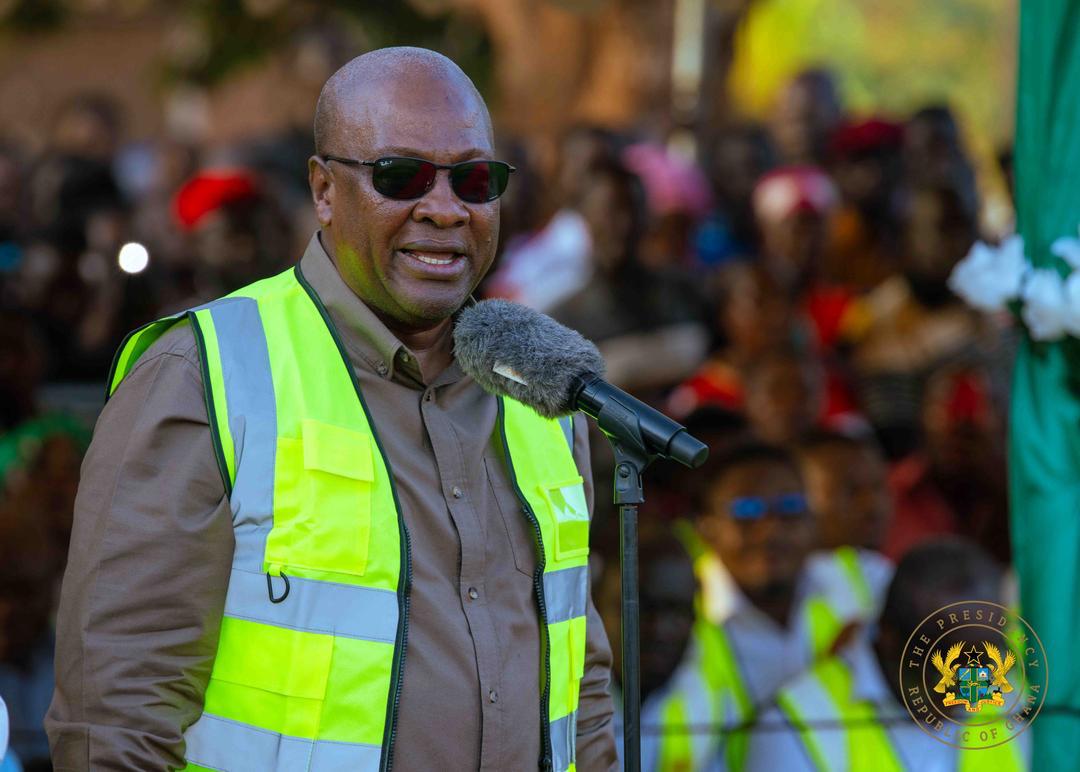
President John Dramani Mahama has achieved a 71% job approval rating, up from 67% in March 2026, according to the latest National Tracking Poll released by Global InfoAnalytics on Sunday, June 15.

The polling firm described the figure as the highest approval rating recorded for any sitting Ghanaian president in its regular tracking surveys since 2020. Only 23% of respondents expressed disapproval of the President’s performance, while 6% said they had no opinion.
Majority Believe Ghana Is on the Right Track
The survey found that 66% of Ghanaians believe the country is moving in the right direction, compared to 27% who think it is headed on the wrong path. These figures remain largely unchanged from the poll’s March findings.
Regionally, the President recorded his strongest approval ratings in the Savannah Region (86%) and Western North Region (82%). Other notable ratings included 76% in the Western Region, 73% in Greater Accra and 70% in the Central Region.
The lowest approval ratings were recorded in the Ahafo Region at 40%, followed by the North East Region at 52% and the Ashanti Region at 55%.
Sharp Political Divide in Approval Ratings
Support for the President varied significantly along party lines.
Among supporters of the ruling National Democratic Congress (NDC), 91% approved of his performance, while only 6% expressed disapproval. Among New Patriotic Party (NPP) supporters, approval stood at 37%, with 54% disapproving.
Independent or floating voters also gave the President positive ratings, with a majority expressing approval and a smaller proportion disapproving of his performance.
Government Performance and Living Standards
When respondents were asked to assess the government’s overall performance, 22% rated it as excellent, while 47% described it as either good or very good. Only 13% considered the government’s performance poor or very poor.
The poll also indicated growing optimism about personal economic conditions. Fifty-seven per cent of respondents said their standard of living had improved compared to a year ago, while 16% reported a decline and 23% said conditions had remained unchanged.
Looking ahead, 68% of respondents expressed confidence that their living standards would improve over the next 12 months.
Unemployment, Economy and Dumsor Remain Key Concerns
Despite the positive assessments, respondents identified unemployment, the economy and electricity supply challenges as the areas where government performance remains weakest.
Unemployment topped the list, with 44% of respondents identifying it as the government’s most significant challenge. This was followed by concerns about the general economy at 32% and recurring power supply issues, commonly known as dumsor, at 29%.
Corruption Perceptions Improve
The survey found that 54% of respondents believe corruption has declined in Ghana, while 21% said the situation has worsened.
When asked which institution is best positioned to tackle corruption, 36% said both the Attorney General’s Department and the Office of the Special Prosecutor (OSP) are equally capable. Among those who preferred one institution over the other, 24% favoured the Attorney General, while 16% selected the OSP.
Support for Tougher Discipline and Younger Leadership
The poll also examined public attitudes toward examination malpractice and school discipline.
Sixty-seven per cent of respondents supported publishing photographs of adults caught engaging in examination malpractice as a deterrent, while 13% opposed the proposal.
On school discipline, 38% favoured the reintroduction of corporal punishment, 27% supported suspension, and 20% preferred community service as a disciplinary measure.
Regarding future political leadership, 57% of respondents said they would prefer Ghana to be led by younger people, compared to 26% who disagreed.
Support for younger leadership was strongest in the Savannah Region (89%) and Upper West Region (82%), while majorities in the Ashanti, Bono and Western North regions did not share the same view.
When asked what age they considered too old to lead the country, 46% said 65 years and above, 17% selected the 50–54 age range, while 21% stated that age should not be a factor in determining leadership suitability.
Poll Methodology
The survey was conducted between May 30 and June 12, 2026, and sampled 8,784 voters across all 16 regions and 84 constituencies. Of the respondents, 7,484 were interviewed face-to-face, while 1,302 participated through online platforms.
According to Global InfoAnalytics, the poll has a confidence level of 99% and a margin of error of ±2.5%.


