


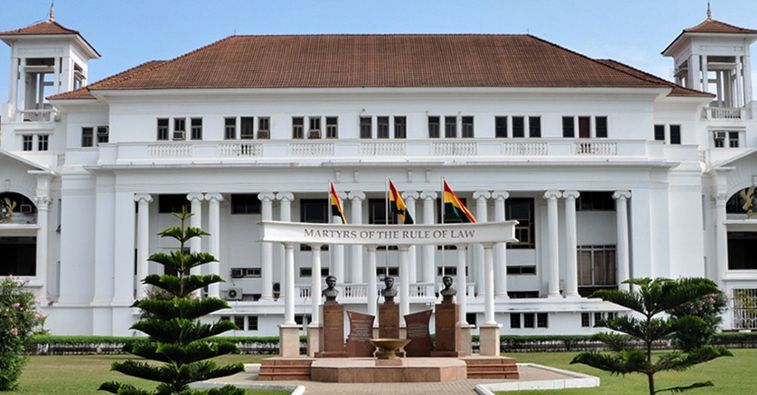
The Supreme Court has ruled, by a 5–2 majority decision, that all registered members in good standing of political parties must be allowed to vote in the election of their party leaders and candidates, effectively replacing Ghana’s long-standing delegate system with a “one member, one vote” model.

The landmark ruling is expected to significantly reshape the internal governance of political parties and the conduct of future presidential, parliamentary and executive primaries.
A seven-member panel of the apex court delivered the judgment on Wednesday, July 29, bringing to an end a constitutional challenge filed by former Minister for Environment, Science, Technology and Innovation, Prof. Kwabena Frimpong-Boateng; veteran politician Dr Nyaho Nyaho-Tamakloe; and former Minister for Lands and Forestry, Dr Christine Amoako-Nuamah.
The plaintiffs argued that limiting voting rights to a select group of delegates violated the democratic principles guaranteed under Ghana’s 1992 Constitution.
For decades, the country’s major political parties—including the New Patriotic Party (NPP), the National Democratic Congress (NDC) and the Convention People’s Party (CPP)—have relied on delegate-based electoral colleges to elect presidential candidates, parliamentary candidates and national executives.
Under that system, voting rights were reserved for selected party executives, constituency officers and accredited delegates, while the majority of ordinary party members were excluded from directly choosing their leaders.
The plaintiffs contended that the arrangement created inequality among party members by granting electoral rights to a privileged minority while denying the same rights to ordinary members in good standing.
They argued that political parties, as institutions recognised under Article 55 of the Constitution, are constitutionally required to organise and operate according to democratic principles, making broad participation in internal elections a constitutional requirement.
The Attorney-General’s Department supported the challenge and urged the Supreme Court to endorse a “one member, one vote” system.
According to the state, political parties perform an essential public function within Ghana’s constitutional democracy, and their internal electoral processes should reflect the constitutional principles of equality, participation and universal suffrage.
The Attorney-General further argued that extending voting rights to all registered members would strengthen internal accountability and deepen democratic governance within political parties.
Among the reliefs sought, the plaintiffs asked the court to declare the delegate systems contained in the constitutions of the NPP, NDC and CPP unconstitutional. They also requested orders compelling the parties to amend their constitutions to guarantee equal, direct and meaningful participation by all members in good standing.
In addition, they sought directives requiring the Electoral Commission to ensure that political party constitutions comply with the democratic requirements of the 1992 Constitution and the Political Parties Act.
The Supreme Court’s decision is expected to trigger significant constitutional and organisational reforms within Ghana’s political parties as they prepare for future internal elections under the newly affirmed “one member, one vote” principle.


