


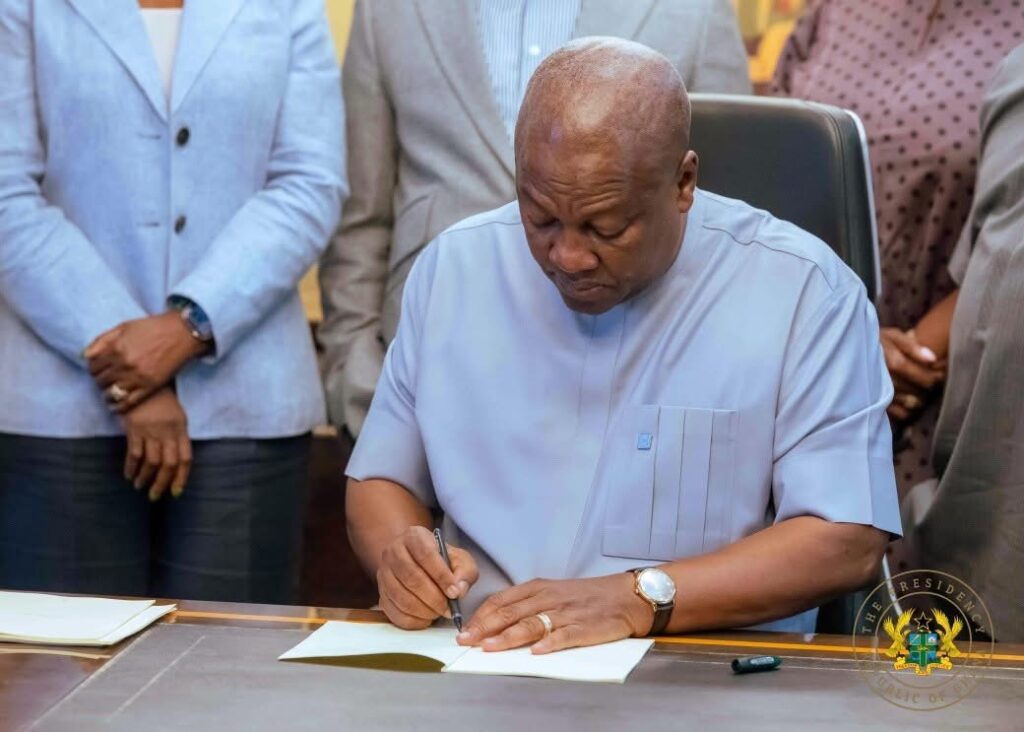
The Minister for Communications, Digital Technology and Innovations, Samuel Nartey George, has expressed confidence that President John Dramani Mahama will honour his commitment to assent to the Human Sexual Rights and Family Values Bill once it is formally transmitted to him by Parliament.

Speaking on JoyNews’ Newsfile programme on Saturday, May 30, following Parliament’s passage of the bill, Mr. George commended the leadership of Parliament and members of the Constitution, Legal and Parliamentary Affairs Committee for their efforts in advancing the legislation.
He reserved special praise for the Chairman of the Committee, applauding his leadership and commitment in guiding the bill through the legislative process.
According to Mr. George, the current committee demonstrated remarkable efficiency in handling the legislation compared to the previous Parliament.
“It took us three years under the previous leadership of the committee, but barely eight months under Honourable Shaibu to get here,” he said.
With Parliament having approved the bill, Mr. George explained that the legislation would now undergo the remaining parliamentary procedures before being forwarded to President Mahama for consideration.
He expressed optimism that the bill would reach the President within the coming week and stated that he fully expects the President to sign it into law.
“We will demand of the President to sign the bill because I am hoping that he made that commitment. I expect President Mahama to be a man of his word,” he stated.
The Ningo-Prampram MP also addressed criticism from some members of the public who had previously accused him of remaining silent on the legislation after his appointment as a minister.
According to him, such criticism failed to appreciate the legal circumstances surrounding the bill, noting that there was no legislation before the President at the time.
Mr. George explained that a constitutional debate emerged regarding the status of the earlier version of the bill after the dissolution of the Eighth Parliament.
“My original belief was that once Parliament had passed the bill and transmitted it to the President, Parliament had completed its work unless the President formally returned it with specific objections,” he said.
However, he acknowledged that a different legal interpretation ultimately prevailed. Under that view, the bill lapsed with the dissolution of the previous Parliament, requiring it to be reintroduced and reconsidered by the current legislature.
The Human Sexual Rights and Family Values Bill has remained one of Ghana’s most debated pieces of legislation in recent years.
Supporters argue that the bill is necessary to preserve Ghanaian family values, cultural traditions and social norms. Critics, however, contend that the legislation infringes on the rights and freedoms of LGBTQ+ individuals and could have broader implications for human rights, constitutional protections and Ghana’s international relations.
With Parliament now having approved the bill, national attention is expected to shift to the Presidency as Ghanaians await President Mahama’s decision on whether to assent to the legislation.


