


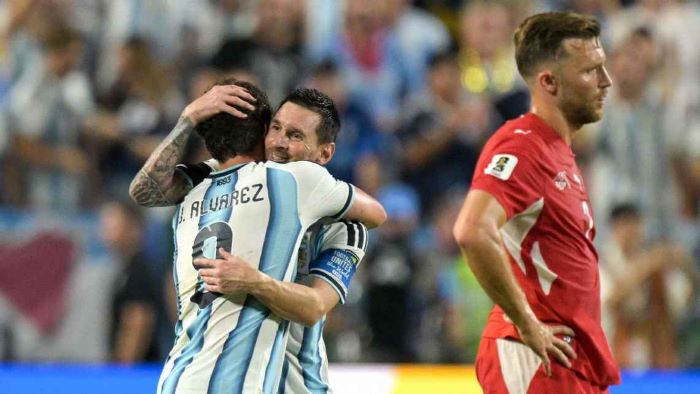
Against a brilliant Switzerland defense that had kept them scoreless for more than 100 minutes, Argentina needed a miraculous extra-time effort to win Saturday’s quarterfinal 3-1 and avoid a penalty shootout.

The defending FIFA World Cup champions eventually got the winner from Julián Álvarez in the 112th minute. The 26-year-old, scoreless in the tournament until that point, uncorked a beautiful, curling effort from 24 meters out, beating goalkeeper Gregor Kobel and giving Argentina the lead with just minutes to spare. The Albiceleste will now play a mouthwatering semifinal against England in Atlanta on Wednesday.
Argentina led for nearly 60 minutes following Alexis Mac Allister’s headed goal from a corner — their fifth set piece goal of the tournament — but Dan Ndoye tied things up with a goal from a tight angle in the 67th minute. Switzerland had controlled the ball all night and were playing on the front foot, but the tenor of the match changed when Breel Embolo received a second yellow card for simulation in the 72nd minute and was ejected from the game.
From that point forward, Argentina attempted 17 shots to Switzerland’s two. After Álvarez’s go-ahead effort, Lautaro Martínez scored on a breakaway to put the match away.
For the third straight match, however, Argentina played with fire. They went to extra time with Cape Verde in the round of 32 before getting a winner via an own goal in the 111th minute. Against Egypt in the next round, they trailed 2-0 in the 79th minute before a late charge and a stoppage-time winner from Enzo Fernández saved them.
With legend Lionel Messi failing to find space in the box — he still finished with six chances created, four shots from range and an assist on Mac Allister’s goal — Argentina needed someone else to create some magic. Álvarez stepped up. — Bill Connelly
Messi quiet, but Argentina carries on
Messi ended the match with just the one assist after Switzerland managed to quiet the Argentina captain just enough to break his goal streak.
Before Saturday’s game, Messi had recorded a goal in nine consecutive World Cup matches and became the first player to score in six consecutive knockout games.
Switzerland held the 39-year-old to just one shot in regular time and three shots in the entirety of the match. Messi, being the player that he is, continued to impact the match through his spatial awareness and ability to move the ball around.
Argentina manager Lionel Scaloni has built a team strong enough team to win matches without a glimpse of Messi magic, relying on Mac Allister, Álvarez and Martinez to get them over the line in Kansas City.
Embolo’s brain fade changed the match
Switzerland had dominated most of the second half and had finally equalized thanks to a lovely, tight-angle goal from Ndoye. They had created 18 touches in the box to Argentina’s four. Though the hydration break was approaching, the Europeans looked like the team more likely to score next. And then Embolo made a decision Swiss fans will think about for quite a while. Turning away from defender Leandro Paredes, he slipped to the ground and acted like he had been fouled.
Referee Joao Pedro Silva Pinheiro initially gave Paredes a yellow card, but VAR intervened: A check for mistaken identity determined that Embolo had simulated the foul and gone down without contact. As the striker had already received a yellow card for a rough foul on Paredes late in the first half, he was gone. And the match was one-sided from there.
Over the final 47 minutes of regulation and extra time, Argentina created 1.61 xG to Switzerland’s 0.03 and finally scored twice in the second overtime period.
The possession rate before Embolo’s red card? Switzerland 54%. The possession rate after? Argentina 76%.
You will rarely see a more game-changing — or, honestly, embarrassing — red card. — Connelly
‘Focus’ issues continue to plague Argentina
Argentina continues to struggle defensively. The Albiceleste have now conceded five goals in the past three games, an issue rooted in a lack of concentration according to defender Lisandro Martínez.
“We don’t like conceding goals, and we definitely need to be a little more focused. I think that with better concentration, we can avoid those goals,” Martínez said. “It’s part of the game, it’s better that it happens now, that we’re more focused, with our feet firmly on the ground, and we can avoid those scoring opportunities.”
The back line managed to hold off Switzerland for the most part, but a lapse of only a few seconds in the 67th minute was all Ndoye needed to capitalize on a weakened defense.
Argentina kicked off the tournament defensively strong, conceding only one goal in three group stage matches. Even when Austria dominated on the attack with six shots, Argentina managed to hold onto a clean sheet.
But the knockout rounds of the tournament have showed a clear weakness in the defending champs. Could it be the distance traveled? Or exhaustion of playing extra time against Cape Verde before facing a physically demanding Egypt? Sure, but that’s part of the rigors of playing a World Cup. Argentina’s back line must be far better against England. — Becherano=ESPN


