


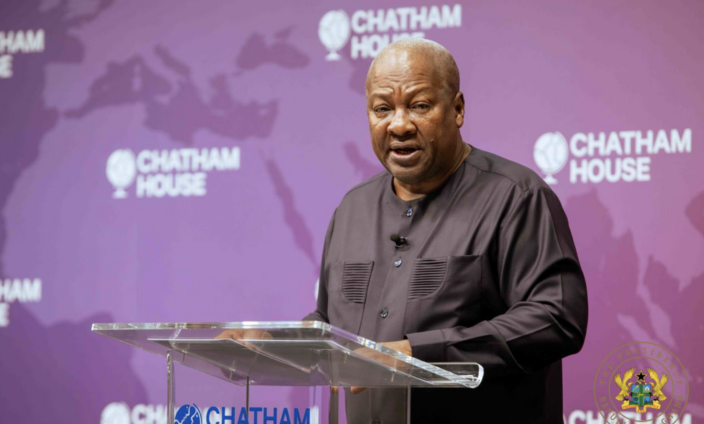
President John Mahama has reaffirmed the strength of Ghana’s diplomatic relations with South Africa despite recent xenophobic attacks that have forced the evacuation of hundreds of Ghanaian nationals.

Speaking at Chatham House, a leading policy institute in London, during his five-day official visit to the United Kingdom, the President described the attacks as unfortunate and expressed concern over growing hostility toward foreign African nationals in South Africa.
“We do not have any breach in our diplomatic relations. What happened was that it’s not the first time there have been these xenophobic attacks in South Africa,” Mahama said in response to a question on relations between the two countries.
“They say we shouldn’t call it xenophobia. I don’t know what else or what name you can give it. But there have been these surges in anti-foreign attacks.”
The President noted that previous incidents had largely affected nationals from neighbouring countries such as Mozambique, Malawi, Zimbabwe and Nigeria. However, he said the latest wave of attacks had increasingly targeted Ghanaians.
“Lately, Ghanaians have gotten involved. This is the first time we’ve really had Ghanaians becoming part of the target of these attacks,” he said.
Mahama explained that deteriorating security conditions and attacks on foreign-owned businesses compelled the Government to organise voluntary evacuations for citizens who felt unsafe.
He noted that many Ghanaians living in South Africa are skilled professionals and entrepreneurs operating businesses in sectors such as barbering, hairdressing, beauty services and nail care, all of which contribute to local economic activity.
According to the President, foreign-owned shops were forced to close during the attacks, while many migrants feared moving freely due to the risk of being identified and assaulted. He added that the situation worsened following reports of raids on health facilities.
“And if you were not South African, you were asked to leave the hospital. Even if you were ill, it created a very toxic atmosphere,” he said.
Mahama revealed that many displaced Ghanaians from Durban and other communities sought refuge at Ghana’s High Commission in Pretoria.
“At this point, we had nearly 200 of our citizens in our embassy,” he said.
The President explained that the Government decided to begin evacuations after concerns grew over the safety of Ghanaians and what appeared to be a slow response from authorities.
“It didn’t look like the South African authorities were doing anything to try to quell what was happening and also to provide protection to those who had been displaced,” he said.
Ghana subsequently organised its first evacuation flight and plans to conduct two additional flights for those wishing to return home.
“We’re going to do two more to take those who want to leave. It is voluntary. We asked, ‘Do you want to stay or leave?’ And many of them say they feel threatened. And so they want to leave,” he said.
Mahama stressed that the incidents highlight the need for deeper cooperation among African nations and renewed efforts to address barriers to continental integration.
“I think it’s unfortunate what is happening in South Africa. We need to drill down to what causes these flare-ups in terms of xenophobia,” he said.
The President argued that African countries should support South Africa in addressing the economic and social conditions that contribute to periodic outbreaks of anti-foreign sentiment, particularly high unemployment and persistent inequalities rooted in the apartheid era.
“And so all of us must empathise with South Africa or must sympathise with South Africa,” he said.
“We must help South Africa to be able to drill down and find out what it can do to reduce unemployment rates amongst the black populations.”
Mahama suggested that some of the tensions stem from structural challenges dating back decades and questioned the belief that migrants are responsible for economic hardship.
“After the last fellow African leaves, is it going to change unemployment among blacks in South Africa?” he asked.
“After the last shop has been closed and everybody has left, will it change unemployment in South Africa?”
The President reiterated that migration benefits both host countries and migrants, pointing to the contributions of Ghanaian professionals abroad and foreign nationals working in Ghana.
He noted that Ghanaian doctors, nurses, academics, entrepreneurs and skilled workers have contributed significantly to economies across the continent, including South Africa, while South Africans, Nigerians and Sudanese continue to play important roles in Ghana’s development.
“Everybody brings some advantage. They either bring their knowledge or they bring investments,” he said.
“And I think we should get over this fear of foreigners coming into our countries.”
The first batch of 300 Ghanaians evacuated from South Africa arrived in Accra on May 27, with further evacuation flights expected in the coming days.


